BBA students build a Whitehall rowing skiff


Boat Building Academy students Luke Cooper, Casey Milburn and Seby Rubatto built this 14ft 9in by 4ft Whitehall rowing skiff made of glued plywood this summer.

Luke, who is from Devizes, was 18 years old when he joined the academy and had just completed A levels – the story goes that he met BBA graduate Ian Thomson at the Southampton Boat Show and  immediately decided to sign up for the long course.

(Ian was at the show exhibiting his now well known Nestaway boats range of nesting boats, which he’d started to develop when he was on the 38-week BBA course.)

When Luke visited the academy for an interview before joining the course, he noticed a similar Whitehall skiff that 2010 season student Matt Cotterill was building at the time, and so Luke decided to build the same boat on his course. There’s a diary of Matt’s build here.

The boat itself was built from a Robert A Pittaway design obtained from the Mystic Seaport Museum in Connecticut, and appears in the book 87 Boat Designs – a Catalogue of Small Boat Plans from Mystic Seaport. The plan dates from 1973, and the original boat is said to be still in service at Mystic.

The book Aak to Zumbra- a Dictionary of the World’s Watercraft states that a Whitehall skiff was originally used on the Columbia River in the mid-19th century.

I gather Luke is pleased with the boat and plans to keep it as a rowing boat for himself and his family to use.

Before relocating to Lyme, Casey lived in Antibes in south-eastern France, raced Optimists and Lasers, and from the age of 15 began spending his holidays teaching sailing at Club Nautique D’Antibes.

He completed his Yachtmaster qualification at the age of 18, and then spent three years crewing on super yachts before attending at the BBA.

Casey has returned to France where he is working with friends developing a boat repairs and maintenance business.

Seby came to the BBA from Trieste in Italy – it was his first visit to the UK, and so he spent his time both learning boat building and improving his English. Seby has now returned to Italy and is looking forward to starting a career in boat building.

Boat Building Academy launch day, summer 2012 – Sunrise


Despite wet weather, a crowd of friends, family, BBA staff, past graduates and even the Lyme’s Mayor joined the 18 students on the Academy’s 38-week course to celebrate completing nine months of hard work.

Sunrise, above, was the first student boat to hit the water. A 13ft by 5ft 6in traditional clinker-built dinghy planked in larch, she was built by students George Herivel and Will Heward, and will be used for rowing and sailing.

Academy instructor Justin Adkin designed Sunrise using photographs of a boat that George’s family owned in Alderney, and then created a half-model of the boat to ensure that he was happy with the design. Justin suggests that some future students may wish to build the same boat, as it has good freeboard, a full transom and firm bilges – between them, these features should give the boat a secure feel, lots of bouyancy and the ability to stand up to its sails.

Goerge says he wanted to build a boat with the same stability and handling in fairly heavy weather as the original and has been completely happy with the outcome – the boat was sailing on Lake Windermere only last week, and although the breezes were light it still performed and handled extremely well.

He added that it can accommodate up to four comfortably when sailing, and six when rowed.

Before coming to the BBA, George, who is originally from Alderney had retired from the Army and was living in Plymouth, where he worked in a variety of roles as transport manager, carpenter and also assistant manager for Screwfix.

George has returned to Plymouth following his graduation from the BBA and aims to work in the boat building industry with a view to starting his own business – his aim is to specialise in traditional boat building methods.

Will is originally from West Dorset but spent four years working around Australia before starting at the BBA.

After graduating, Will gained a position at Spirit Yachts of Ipswich in Suffolk and is due to begin work in August.

Interior and fittings of Victorian gentleman’s racing cutter Integrity


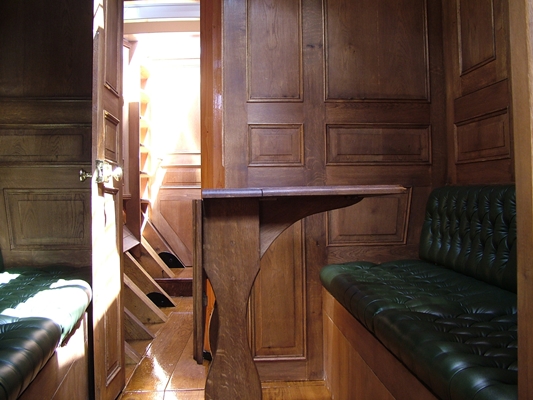
These photos of the recently launched Victorian gentleman’s racing cutter Integrity designed and built by Stirling & Son of Tavistock in Cornwall are an illustration of how much research and thought has gone into this boat.

As usual, click on the thumbnails for a better view!

Here’s what Will Stirling has to say:

‘The detail of the interior has been taken from photographs of Victorian yachts. The frames of the panelled oak bulkheads are mortice and tenoned together. Loose panels are fitted in a rebate in the frame. The lower panels are fielded, while the upper panels are flat, and a beading or trim is fitted around the edge of each panel to give the bulkhead a three-dimensional feel.

‘The oak has been treated with Van Dyke crystals, a crushed walnut and water mixture that stains the wood and brings out the quarter grain – you might find something similar in old panelled libraries. Once stained, beeswax is rubbed into the oak and then buffed.

‘I have been collecting fittings for some time. I have managed to collect a full set of brass clam lights with switches to suit, the sink is of hammered copper with a brass galley pump. The Blakes Minor heads has a hand-painted ‘bird bath’ basin next to it with a brass soap holder that came from an old ocean liner.

‘In the next few weeks I hope to get some good sailing shots and shall send them over.’

‘Best wishes, Will’

Stirling & Son traditional yacht builders and wooden boat repairers can be contacted via their website or by phone on 01822 614259.